Standing water after a storm sends most people searching for yard drainage solutions to make the puddle disappear.
Hoping to fix it, they try one thing at a time: a channel drain here, a bag of gravel there.
But the puddle is only a symptom. Water sits in one spot because of something happening elsewhere: the grade, the soil, the roofline, or the slope above it.
Read on to find out:
- Why water pools and where it comes from
- How to establish what the problem is
- The main yard drainage solutions and when each one fits
- How the right landscaping can help with runoff and erosion
- When you need to call a professional
Why Is Water Pooling in Your Yard
Water collects when it cannot soak down or move to another place.
In Santa Fe, a few local conditions can make the situation worse.
Heavy clay that’s common in the area absorbs water slowly, while ground compacted during construction barely takes it at all.
When soil is bone dry, even the first hard rain runs off before it can soak in.
Many lots also have a caliche layer underground, a hard, cement-like band that water can barely pass through, so it backs up in the soil above it. The result is standing water in your yard.
Grade is another reason. If your property has slopes leading to the house, water runs straight to the foundation, where it can seep in, lead to cracks, and damage the structure.
Add one of Santa Fe’s summer monsoons and downspouts and patios that collect runoff on small areas, and the challenge is there.
How To Diagnose a Yard Drainage Problem
The best time to spot a drainage problem is during or right after a storm.
Watch what the water does:
- Where it collects and how long it stays
- Which way it flows
- Whether it goes toward the house or away from it
- Where each downspout empties and what happens after that
Then observe the ground.
- If the water sits on top and drains within a few hours, it’s likely surface water that just needs somewhere to go.
- If the ground stays soggy for days, water is trapped below and needs a way down or out.
Once you know these details, you can match them to the right solution.
Yard Drainage Solutions and When To Use Them
Wondering how to fix yard drainage?
Different problems require different solutions. Here are some of the most common ones on Santa Fe properties.
Yard Grading for Drainage
Grading shapes the ground, guiding water away from the house toward a safe outlet.
It’s usually the first fix, when water pools against the foundation or sits in broad, shallow spots.
Surface and Channel Drains
These are set into the ground, catching water and leading it away. They come in two forms: a surface drain is a catch basin that sits at a low point; a channel drain runs along the edge of a patio or driveway.
Use them for puddles on hardscape or a low spot you cannot regrade.
French Drains
A French drain is a trench filled with gravel with a perforated pipe that collects water from the soil and carries it away.
It’s a good solution when the ground stays soggy, a bed holds water, or moisture is seeping toward a wall.
Dry Wells
A dry well is an underground basin that holds runoff and lets it soak into the ground slowly.
It’s typically used to direct water from a drain or downspout somewhere when there is no outlet nearby.
It only works where the soil below actually drains, so caliche has to be ruled out first.
Swales
A swale is a shallow, planted channel that slows water and guides it across the surface, letting some soak in along the way.
Santa Fe homeowners prefer this solution for runoff down a slope, or to carry roof and driveway water along a set path.
Dry Creek Beds
Shaped as a stone-lined channel, a dry creek bed for drainage follows the route water already takes.
Here the rocks work two ways, carrying storm runoff to a safe outlet and holding the soil against erosion.
How Landscaping Can Help Control Runoff and Erosion
You may think that only pipe and gravel can solve the yard drainage issue. The truth is plants and a well-shaped grade can move water just as surely.
When planted on a slope, native desert landscape plants like Blue Grama and Winterfat hold soil, and their roots loosen the ground so water soaks in.
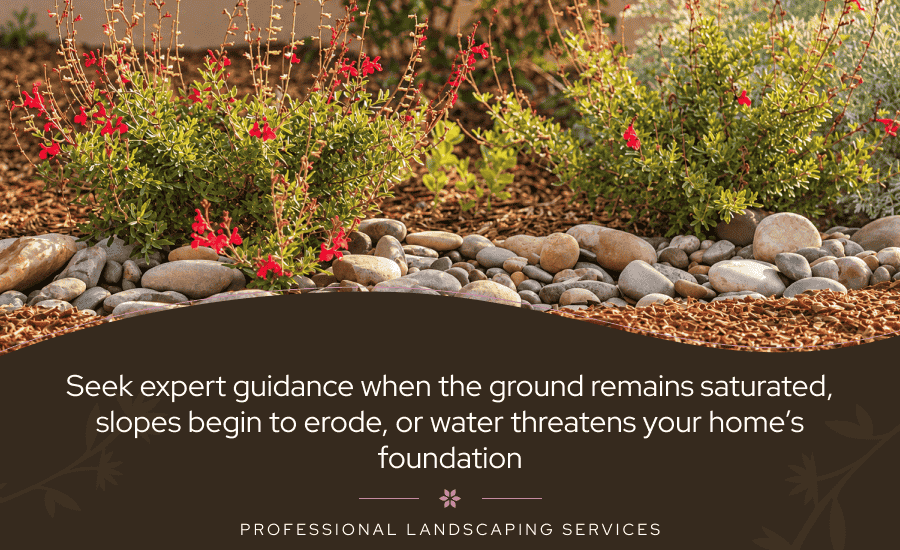
Gravel beds and mulch slow the flow and take the force out of runoff before it can carry soil away.
The strongest results come when drainage is planned together with all other landscaping elements, protecting the yard and looking as a natural part of the overall design.
When To Call a Professional for Yard Drainage Problems
Consider bringing in a professional agency that knows yard drainage solutions when:
- The water threatens a foundation.
- A slope is eroding.
- The ground stays soggy.
- There’s clay and caliche involved.
Experts read the whole site, including where water originates, where it can go, what the soil will and will not allow, and how drainage fits with the rest of the yard.
They make the difference between a drain that works for one season and a yard drainage solution that holds for years.
Looking for Landscape Drainage Solutions? Call Urbanna Landscaping
Santa Fe drainage has its own rules, and Urbanna Landscaping has spent 24 years learning and implementing them across various properties and conditions.
We’ll visit your property, observe and map water movement, and design around the grade, the soil, and the landscape your situation requires.
From our first meeting and assessment through installation and maintenance, our team of experts handles every stage of the project.
That way, the water is handled, and you don’t have to worry about it every time it rains.
Yard Drainage Solutions: FAQs
What is the fastest way to fix standing water in a yard?
It depends on the cause. When water collects against the house, regrading and extending the downspouts often help quickly. When the ground remains wet, it’s worth considering a French drain or a dry well. Call Urbanna Landscaping to discuss the right yard drainage solution for your property.
Does yard grading fix drainage problems?
Often, yes. Yard grading handles pooling near the foundation and shallow low spots. It moves water away from the house, and when done right, facilitates the installation of other solutions.
Will a dry creek bed work for drainage in Santa Fe?
Yes, as long as it is built to carry real storm flow. A properly graded dry creek bed moves monsoon runoff to a safe outlet and handles the volume local storms bring. During the sunny months, it stands on its own, especially when the stones are softened by flowers planted along its edges.

- Yard Drainage Solutions: How To Fix Standing Water and Runoff - October 15, 2026
- Drip Irrigation Systems: A Santa Fe Installation, Design & Maintenance Guide - October 15, 2026
- Landscape Lighting Cost: Price Breakdown and Budgeting Tips - July 28, 2026